22 deg halo
The common ring around the sun and the scale reference for the atlas.
circle(sun, R22)
rendered-corescale-lock
Vocabulary ledger, not the atlas
A public dictionary for the optical phenomena and site terms around the Sundog atlas. The atlas is the visual geometry page; the h-of-x math page walks through the first promoted inverse equation. This legend keeps the broader vocabulary honest by separating rendered primitives, optional labels, named-only literature, and not-modeled halo families. Comparator terms such as posterior, misspecification, and substrate-conditional evidence belong on the alignment primer.

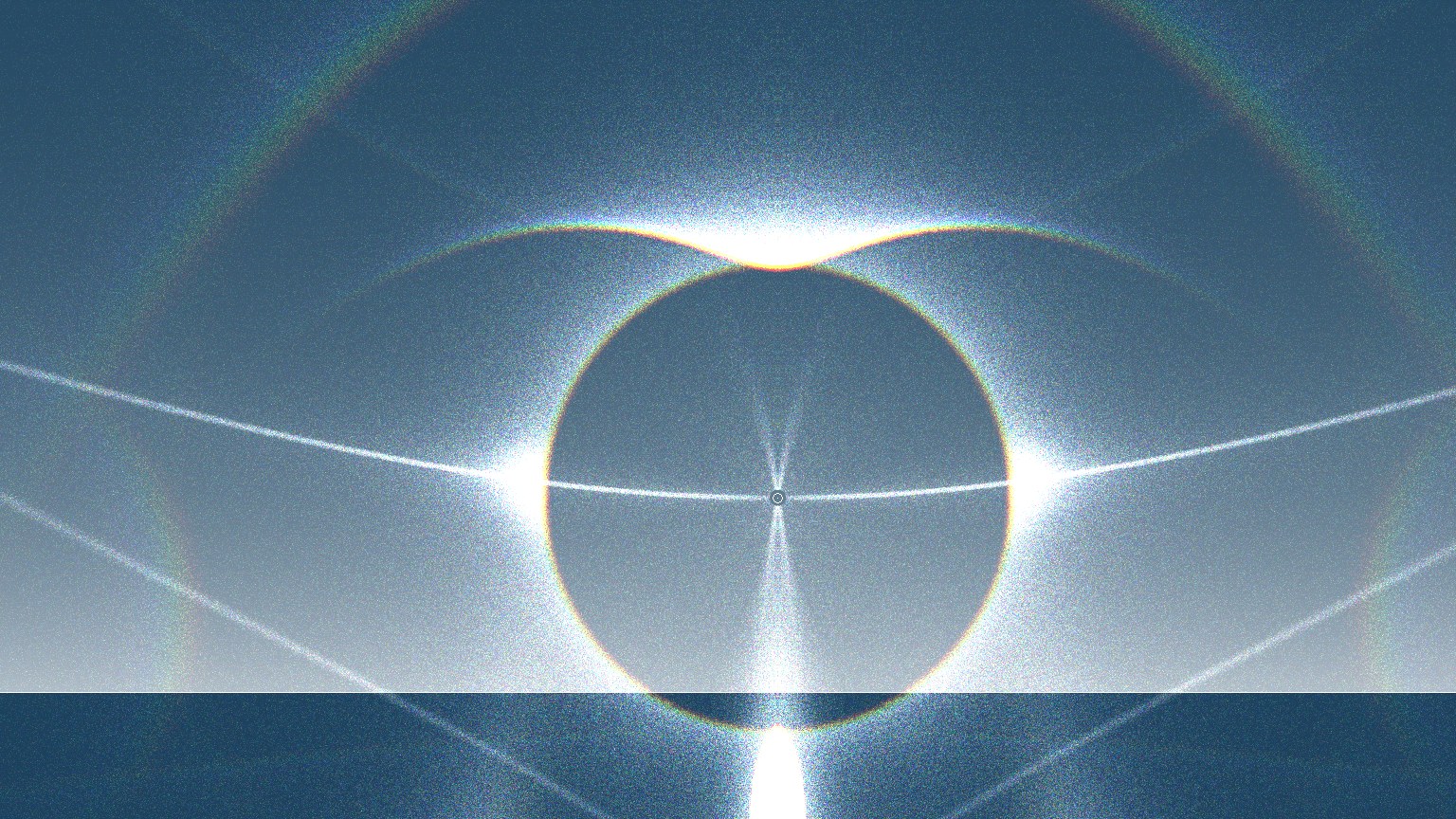
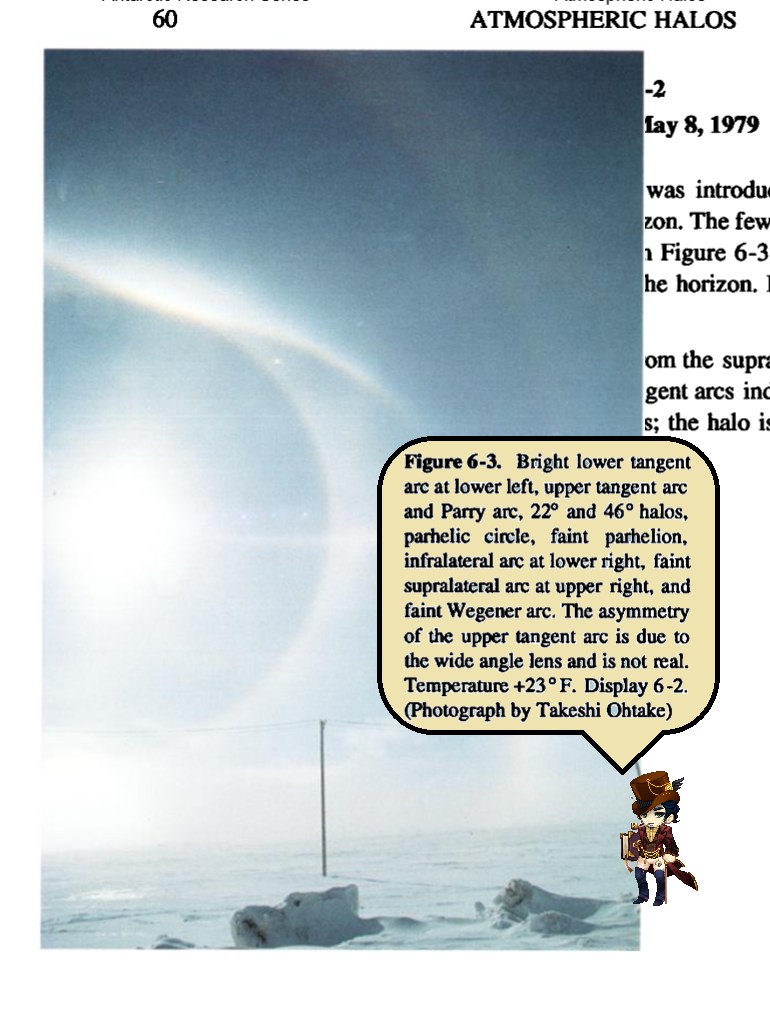
These are the primitives shown or named in the current atlas. Only the parhelion-offset route is promoted as an inverse measurement handle.
The common ring around the sun and the scale reference for the atlas.
circle(sun, R22)
A larger halo used as context for CZA, supralateral, and infralateral vocabulary.
circle(sun, R46)
Bright flanking spots on the parhelic circle. The offset recovers sun altitude when the anchors are eligible.
offset = R22 / cos(h)
The horizontal belt through the sun and parhelia. It is rendered, but not promoted as a hidden-state handle.
circle through sun and parhelia
The high smile-shaped arc. The current route is visibility-gated; pre-A1b anchors need rechecking before proof use.
visible when h < 32.196 deg
High arc near the 46 deg halo/CZA region. The inverse route failed coverage and structural-discrimination gates.
46 deg family context
Column-crystal tangent vocabulary above the 22 deg halo. It remains useful for logo language, not inverse proof.
tangent-family candidate
A Parry-family cap near the upper tangent arc. It is optional vocabulary with weak photo support.
Parry-oriented family
The lower counterpart of the upper tangent family, tied to low-altitude/observer geometry.
22 deg lower tangent family
Parry-family shoulders near the 46 deg top region. Coverage and weak evidence blocked promotion.
Parry + 46 deg family
Lower-side 46 deg family vocabulary. Present as periphery language, not a calibrated inverse route.
46 deg lower-side family
A vertical light column from plate-crystal reflection. The atlas renders it as stylized visual vocabulary.
plate-crystal reflection
These rows keep the vocabulary visible without pretending the atlas already accounts for every halo family.
Includes suncave, sunvex, and Parry supralateral members. Some are optional labels today; the family still needs subrows and HaloSim receipts.
Faint odd-radius rings from pyramidal ice crystals. HaloSim reproduces the family, but the atlas does not model it and the quantitative ring-isolation route topped out below promotion.
Arcs from rotating plate orientations, historically contested and now photographically observed. Not modeled here yet.
Anthelion, anthelic arcs, paranthelia, and 120 deg parhelia live opposite or far around from the sun.
Subsun and subparhelia require aircraft, mountain, or below-horizon observer geometry.
A high-sun plate-crystal arc sometimes called a fire rainbow. It is outside the current sundog-facing regime.
These are the project terms that used to be repeated on the homepage. The short version lives here; the math version lives on h-of-x, and the lab posture lives on About.
The indirect signal left in the world: parhelion offset, detector intensity, shadow, pressure field, deformation, local acceleration, or behavior wake.
The rule that makes the trace usable. Sometimes it is closed form, like R22 / cos(h); sometimes it is a bounded controller or measured operating envelope.
The point where the trace stops being enough. A credible indirect route names the boundary where it should fail instead of smoothing that failure into a story.
The terms used on threebody (catalog sidecar) and isotrophy (K_facet v0.3h audit chain). Hover-definition tooltips on those pages anchor to the entries below.
A periodic three-body orbit where all bodies share a single closed inertial-frame trajectory — the same wire — phased thirds of a period apart.
A strict choreography returns to the same wire each period. A relative choreography returns rotated by 2π/3 in SO(3). The σ₃ detector splits 25 → 21 strict + 4 relative.
A gauge-invariant test that compares an orbit's third return to itself. Distinguishes strict-from-relative choreographies by rotation angle, blind to the catalog's labels.
rotation-angle metric on σ₃·X vs X
Li & Liao (2025) supplementary-A table of three-body periodic orbits at m₃ = 1. The 21 strict G.2 single-curve choreographies are the K_facet test's input set.
A pre-registered structural-zero test on the strict G.2 catalog. For each row it asks whether the standard D₃ block is absent in the kernel by construction.
The named artifact class. A row earns one when ci = di = 0 by construction — not by tolerance, not by post-hoc pruning. 20 of 21 rows returned receipts in v0.3h.
A receipt-first, closure-relative, three-stage pipeline: sentinel/Γ runner → adaptive-floor reprocessor → bridge audit. Constants and outcome categories are registered before interpretation.
Stage 2 picks the smallest pre-registered floor satisfying all three: D₃ leakage ≤ 1e-3, gap ratio ≤ 1e-3, first-rejected singular value ≥ 1e-3. No row-specific knobs.
floor ladder: 1e-8 → 1e-5
The standard real D₃ block is a structured T/S/E decomposition. A valid representation is what the audit chain looks for; an invalid one — e.g. T(2) + S(6) + E(1) with odd E — is what trips the bridge audit.
The per-orbit audit operator. A Γᵢ failure would indicate an orbit-specific defect inside the chain. O_617 is not a Γᵢ failure — the defect is downstream, in the bridge representation.
A catalog row whose orientation is admitted by the opposite-strict admission test, with admission residual 1.01e-8 for O_617. The canonical residual 1.62e-1 is diagnostic-only for an opposite-strict row, never an admission residual.
At the bridge-admitted kernel, O_617's representation is not a valid standard real D₃ block. The Jordan-chain test amplifies (90.04) and the order-3 relation fails (‖σ₃³ − I‖∞ = 3.96e-2). The defect lives here, in the bridge representation — not in admission, not in the audit chain.
A row held back from being counted for or against the prediction, with a specific representation-level reason given. O_617 is the sole quarantine in v0.3h. Naming the quarantine is the discipline — absorbing it into a clean number would not be.
The terms used on faraday (Phase 1–5 Shadow Faraday Zero-Out) and safety-method (the bridge essay translating Faraday's Branch A receipt to AI behavioral guarantees). Hover-definition tooltips on those pages anchor here.
A local, gauge-invariant readout that extracts an algebraic quantity from a small spacetime stencil without reconstructing a globally consistent potential. The shape the Sundog method asks of any verifier: small stencil, exact invariance.
The Shadow Faraday realisation of Pshadow: the line integral ∮ A around the boundary of a coordinate plaquette. By Stokes it equals the flux ∫ F; the gauge term drops out around any closed loop.
The readout is unchanged under A → A + dλ by an algebraic identity, not by approximate cancellation. In EM that follows from the holonomy of an exact form vanishing on any closed loop.
The closure residual is zero by an algebraic identity, not by being below a numerical floor. Distinguished from tolerance-based guarantees that report no observed violation across many test cases.
A pre-registered failure class paired with the branch it forces. Shadow Faraday names five: regularity, topology, monopole, operator-stencil commutator, motional EMF. A surprise without a pre-registered class is a Branch C bounded failure.
All registered clean-domain residuals evaluate to exact algebraic zeros. The strongest landing. Shadow Faraday earned Branch A on the registered classical-vacuum domain.
One precisely-named survivor — boundary at infinity, Aharonov–Bohm phase, monopole insertion, a registered topological obstruction. Closure is conditional; the failure is articulate.
A surviving global-reconstruction, gauge-choice, nonlocal, or unregistered residual inside the registered clean domain. The bound is publishable; the prior is updated.
Phase 2 retained both Pshadowpoint (algebraic zero-out object, equal to Fμν in the smooth limit) and Pshadowstencil (locality receipt). Public claims must not blur the two.
The five-clause registered condition on (S, ∂S): oriented C² surface, contractible in U, static in the working frame, plaquette mesh covering S without overlap or gap, mesh respects orientation.
The terms used on generality (umbrella) and navierstokes (Navier-Stokes C1 deep dive), the status-tag taxonomy that distinguishes review-gated, design-hold, cost-hold, and execution-hold lanes, and the cross-substrate failure-mode taxonomy that names why each lane sits where it does.
A constructive witness in the Postulate-1 idiom: pairs of trajectories that agree on a Sundog-style signature to within ε_K also agree on the proxy-action objective. The "Reading 2" regime is where standard determining-modes signals fail to reconstruct full state but a smaller signature suffices for control.
Whether a witness that holds at one Grashof number G on a Kolmogorov-flow cell also holds at a second. The NSE C1 witness now replicates at G = 200 and G = 300; that's the current span.
A control objective designed to transport across Grashof regimes — held-out-quantile rather than a fixed-percentile threshold pinned to one cell.
A portability-gate quantity. The G=300 adjusted damp fraction is 0.2688, well above the v6 0.004 vacuity that motivated the regime-generality pivot.
A pair of trajectories that compose the Reading-2 witness. The G=300 twin-state lock is certified with 942,834 unique pairs, 100% witness coverage.
A named outcome class: pre-registered lanes that returned null verdicts with the specific substrate causes identified. Bounded nulls are receipts, not silent failures. Riemann and Yang-Mills publish bounded-null syntheses.
The eight named ways a cross-substrate generalization fails: marginal (body barely resists its shadow), numerical wall (shadow unmeasurable with current tooling), bounded-null (shadow carries no separating structure), vacuous (rigidity trivially satisfied), cost-bounded (envelope blocks promotion), convergence-to-null (needs a reframing, not another sweep), conditional (rigid only after naming the held-fixed coordinate), deflationary (over-attribution corrected). Cataloguing the mode, not just the negative, is what turns each wall into a design constraint. The public map lives on Generality, with each lane ledger carrying its own scope fence.
A lane whose next move depends on an external review pass. NSE C1, Riemann, and Yang-Mills are currently review-gated. The badge stays prominent on public pages until the gate closes.
A lane whose safety floor is positive but whose cost has not been adjudicated. P-vs-NP v5: safety green, cost-unresolved.
A lane whose witness is in hand but whose promotion criteria are not all met. Public copy carries this badge to refuse collapsing a witness into a theorem-facing claim. NSE C1 remains UNPROMOTED until criterion (c) closes.
How much a body (full state) resists reconstruction from its shadow (a lossy projection) — the axis used to compare public cross-substrate lanes. Two exact poles bound it: Faraday (resistance zero by the Bianchi identity — the shadow reconstructs the body) and Kakeya (resistance maximal — the direction-shadow cannot compress the set below full dimension). The marginal substrates (NSE C1, Mesa, shell) sit between, near-zero by low dimension.
The Kakeya conjecture read on the body-resistance axis: the line direction is the fiber-label / shadow; "informationally incompressible at ambient dimension" is maximal body-resistance. Polson–Zantedeschi (2026) formalize this via conditional Kolmogorov complexity and the Lutz point-to-set principle — the same body/shadow split Sundog uses, reached independently. Honest fence: this is the body-resistance half only. That framework has no control-sufficiency notion, so Kakeya is not a Reading-2 / regime-2 witness — its direction-shadow is "sufficient for the direction" only trivially (it is the direction).
Body-resistance is exact only when the shadow is identifiable — each body maps to one shadow-label. When a point lies on many fibers (many directions through one point), an adversarial oracle can pick whichever direction minimizes description length, undermining the clean split. This identifiability boundary is why Kakeya is resolved in R³ (Wang–Zahl; sticky/Lipschitz neutralizes it) yet open for n ≥ 4.
This legend is a map of current project status, not a claim that Sundog has solved every halo. Phase 14 fills the accounting matrix; Phase 15 is reserved for speculative or unphotographed halos that need math, brute-force ray tracing, atlas comparison, and HaloSim receipts before promotion.