Structural Failure Boundary Map
The falsifier before the agent.
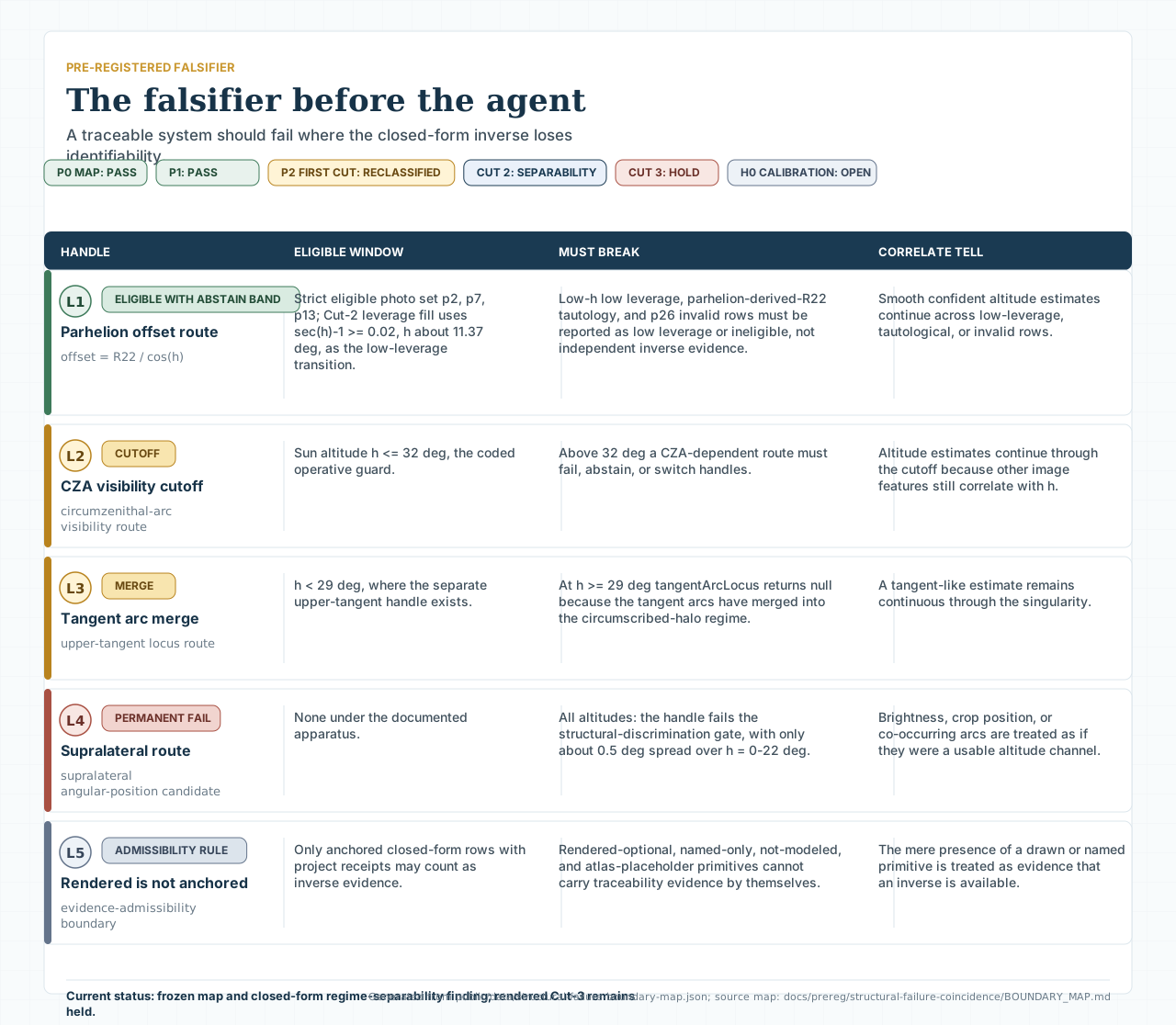
A traceable system should fail where the closed-form inverse loses identifiability. Sundog froze this five-locus map before agent execution so the test cannot be rescued later by a convenient interpretation of success.
Failure Boundary Intuition
The honest move is knowing when the trace stops locking on.
Think of the structure like a drifting floater in your eye: it can be real, but the moment you try to pin it down it slides out from under the reticle. A disciplined trace does not keep reporting a crisp position after that. It says eligible, abstain, or switch handles at the boundary.
How To Read It
What It Is
A pre-registered apparatus map: which indirect handles are eligible, where each handle must fail or switch, and what a shortcut correlate would keep doing past the boundary. It is one of three audit-chain artifacts in the public ledger; the siblings are the mesa-trap operating envelope and the K_facet v0.3h verdict.
What It Is Not
Not a universal proof, not a rendered-signal pass, and not evidence that a probe-readout proves route use. The current public claim is narrower than that on purpose.
Current Finding
The closed-form Cut 2 line produced regime-separability: the route dominates where eligible, while the correlate only substitutes where the route already abstains. The geometry workbench shelf tracks where each closed-form inverse is and is not promoted.
Next Gate
Rendered Cut 3 is open but held. It needs H0 angular calibration, corpus records, baselines, edit operators, and renewed admission before any execution claim.
Inspection Trail